Photography and Art

Sunday, January 15, 2012

Winter Photography Tips

Brrr! It was a cold morning out there, but I was up early and out the door to take a couple of shots that I'd happened on when I was driving into downtown Toronto last night.


The Golden City

After I got back from my little expedition (with my wallet lightened to the tune of $40 thanks to a parking ticket at 9 am on a Sunday!), I checked my e-mail and found a linkedin request from Cary, an old friend. Somehow, we'd lost track and he managed to find my profile. Now we're back in touch. Turns out, he's also taken up photography and he' pretty good at it too (see here). Cary was interested in winter photography and asked me if I had any tips.

As a matter of fact, I love winter photography and take the majority of my images in winter (something to do with getting sidetracked by golf in the summer). Here are a few tips for those of you who don't often get out with your camera in the winter:

  • Dress warmly! Don't be afraid to look like a dweeb. Wear a hat, a scarf and a warm coat. If you are going out into the wilderness in winter, wear a ski suit or a snowmobile suit. This will make your day much more comfortable and could save your life if you get lost or stranded.
  • If you are taking photos in a remote location, take your cell phone with you and make sure you keep it warm so the battery doesn't give out. Join AAA or CAA so that you can get rescued if your car gets stuck. Make sure you have a good idea of where you are at all times.
  • Battery life is much shorter in the winter. Always have a spare with you and keep it close to your body. If you are going any distance in the cold, take your battery out of the camera and keep it inside your coat.
  • The camera doesn't have much difficulty in cold weather, but lenses will fog up when coming inside from the cold. Some people put the lenses in plastic airtight bags outside and then bring them in and let them warm up. This prevents fogging and the danger of mold.
  • Get a carbon fibre tripod. Metal legs are really cold on the hands when you have to carry a tripod any distance. You'll also appreciate the lightness of weight of carbon fibre.
  • Trigger mitts (designed for hunting) are great for photo work. They keep your hands warm when you're not shooting and let you have your fingers to adjust camera settings when you need them.
  • Watch your histogram and adjust exposure. Often, the camera will underexpose snow and make it a dull gray. You might have to increase exposure.
  • Don't be surprised if the snow isn't white. If you're taking photos on a cold, crisp sunny day, the snow will reflect the blue in the sky. In the evening, as the sun sets and turns golden, the snow will turn golden too.


Cathedral of Religion, Cathedrals of Commerce

Friday, January 6, 2012

Predictions for 2012

2012 is going to be a terrific year for photographers. This year was a little lean, due in part to the tsunami in Japan and the floods in Taiwan. If all goes well and natural disasters don't interfere, we'll have lots of new hardware and software to buy in the coming year.

Software
Let's look at software first. In 2012, we are going to see a lot of new stuff. We'll see a new version of Photoshop and a new version of Lightroom. I won't speculate on what's going to be in Photoshop, but I'm very hopeful that Lightroom will offer a few goodies that we've been waiting for. Here is my wish list:

  • Speed: it would be really nice if Lightroom could make use of the GPU in my graphics card like Photoshop does. Why can't the Lightroom team re-use some of that good code?
  • Networking: Most of the people I know have a small network in their house and have at least a desktop and a laptop machine. I'd like to be able to share my catalog on my network. I'm sure that professional photographers have even a more urgent need for this functionality.
  • Cloud integration: the ability to either have my catalog in the cloud or, failing that for performance reasons, have my catalog index images stored in the cloud. Also, let me edit images in my iPad or Android device and have those edits reflected in my catalog.
  • More and better tools: I like the tools that came out with Lightroom 3, but I'd like more control. For example, I'd like to be able to control the gradient adjustment tool so that I can vary the steepness of the gradient.
Cameras - DSLR FF
The first shots have been fired in the pro wars with Canon and Nikon announcing new generation tools for the sports photographer. The Canon 1dX and the Nikon D4 are evolutionary products. Curiously, both vendors seem to be coalescing around a megapixel count in the 16-18 range. This is driven, no doubt, by complaints from customers that they don't want to be messing with large file sizes for editing and uploading where the target vehicle is a web site, newspaper or magazine. Both cameras have sprouted excellent video capabilities reflecting the change in the industry to having reportage in video as well as text/still photography.

The next shots will be fired in the fine art photography space where the Canon 5dmarkIII waits in the wings. Here's where things get interesting:
  • Will it take the next step up to 36 megapixels or will it come in at 18 megapixes, a slight drop in resolution from the current 21 megapixels?
  • Will we see a 3d and a 5dmarkiii? 
  • Will there be a killer video camera with 4K video to drive the 4K TV's that are just starting to come to life? 
I'm going to go out on a limb and suggest that there will indeed be two cameras. One will be an 18 megapixel camera aimed at the video set with 4K video to keep Canon in the lead. The other will be a 36 megapixel art photographer camera aimed at still shooters. 

Of course, there will also be a slew of new APS/C cameras from Canon including the new 7dmkii. 

What will Nikon do? Things are a little clearer in the Nikon camp. There will be a D800 announced soon. It will be 36 megapixels, full-frame and will have video capabilities (probably not 4K).

Cameras - Mirrorless
This is going to be a very interesting spot to watch in 2012. Let's go vendor by vendor:
  • Nikon is all set. The V1 was announced and has been received with mixed reviews. There was some disappointment with the small sensor size, but on the plus side, the camera and lenses are in balance unlike Sony's product line where the camera looks like the tail on the lens dog. Look for more lenses in 2012 to fill out the line-up.
  • Sony is all set. The Nex 7 was announced to pretty much rave reviews for the sensor. DxOmark rates the sensor as better than a 5dmarkii, so it must be pretty hot stuff. The only issue with the Sony mirrorless cameras is the size of the lenses. The APS/C sensor format drives the lens sizes up. Look for more Zeiss lenses in 2012.
  • Canon is missing in action. I guess if you're the big dog, you can wait to see everyone else's strategy and then come into the market late with the winning hand. Will Canon introduce an APS/C camera or something with a smaller sensor? My prediction is that they will follow Nikon and introduce a camera with a smaller sensor. Why? They need to protect their entry-level DSLRs that are huge sellers. They also need to differentiate themselves from Sony, Nikon, Olympus and Panny, so my guess is that we'll see a sensor that is around micro two thirds in size but without joining the consortium. We'll see a full set of lenses and the camera will be loaded with video capability. 
  • Olympus is fighting a PR nightmare and will have a tough time getting over its distracting financial difficulties. We may not see a lot of product in 2012 which is too bad.
  • Panasonic will continue to build on its success in the micro two thirds market and will look to steal share away from Olympus and even Nikon. There will be lenses and bodies announced, but nothing revolutionary.
  • FUJI is going to be in the news. The new X Pro-1 will be out in the first quarter. Think of it as an X100 with interchangeable lenses. Rumors abound that the sensor will have multiple pixels per site like the Sigma Foveon technology. This should be a very interesting camera. Let's hope the image quality is as good or better than the X100! There are also rumors that Fuji will buy Olympus. Wouldn't that be interesting.
Printers and Paper

Epson will announce a model or two with marginally better gamut and performance. Ink prices will stay flat. Snore.

There may be a few new papers announced in 2012, but I think we're also at maturity in that space too. Snore.

In Summary
Get your credit cards out! Before the year is out, most serious photographers will be out buying not one, but two new cameras and a bunch of lenses. First will come the upgrade to either the 5dmkiii or the D800 to get those 36 megapixels. Better also upgrade some of your lenses to take advantage of all that resolution. Maybe a Zeiss lens or two will fit the bill!

Then, we'll all be buying mirrorless systems for those days when a big camera is too bulky or too obvious. The Fuji announcement will create a whole lot of buzz. The Canon announcement will create even more buzz. In short, the light will be shining on this product category all year and people will be lining up to buy as the economy recovers.

Not only that, but you'll have to be shelling out $400 to upgrade Photoshop and Lightroom, assuming that you upgraded to CS5 to avoid having to buy the license for Photoshop all over again.

And if that isn't enough, you should consider upgrading your computer to something with a quad Intel i7 and at least 16GB of memory so that your system doesn't choke on those huge files. Better buy some more disk while you're at it.

This is going to be one expensive year for a lot of people! Buy Japanese yen.

Tuesday, January 3, 2012

Construction Site

There is nothing like a construction site to bring out the little boy in a man. As I mentioned in a previous post, a building next door to my client's office was being torn down. The building is now no more than a stump and the heavy machines that were needed to demolish it are now waiting for pick-up and transport to their next assignment. Just before the holidays, I looked down from the 20th floor and saw this wonderful site of brightly coloured heavy machines in a line-up. Do I hear the theme song to Bob the Builder in the background? Can we do it? Yes, we can!


Tuesday, December 20, 2011

Making Black and White Photos Like Ravilious

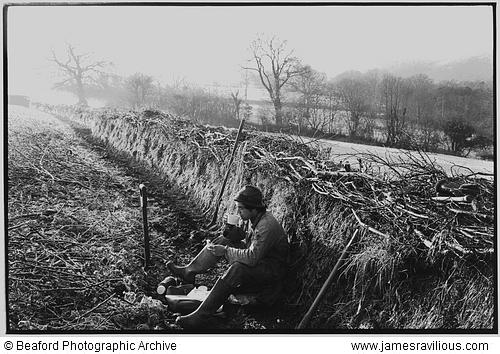
One of my favourite photographers is the late James Ravilious. I reviewed his book, An English Eye, earlier this month. However, try as I might, I just couldn't get my black and white photos (converted from digital colour) to look anything like the photographs of Ravilious.

Let me show you what I mean. Here's a nice photograph of the Bell of Skenfrith on the Welsh/English border.


It's a pretty photograph with a lovely old bridge and a lot of green pastures. Just the sort of countryside that Ravilious would have liked. Here's what I got when I converted this photo into black and white using the default photoshop settings (I used a black and white adjustment layer and didn't touch the settings).


It's an OK image, but most of the pizazz in the colour version has disappeared. For example, the bushes in the foreground have totally lost the highlights that dot the coloured version. In addition, the photo has taken on a dark, gloomy aspect, conveying just the opposite mood of the coloured image. You could swear that it was just about to rain, when it actually was a very nice day (for a change)!

After reading the part of the Ravilious book where the author discusses Ravilious' techniques, I had an "ah hah" moment. It seems that Ravilious just hated black and white photographs with too much drama and contrast. Not only did he seek out older, uncoated lenses that rendered images with less contrast, but he often photographed WITH A YELLOW FILTER on his lens. The light went on for me. I went back into Photoshop and, sure enough, when you use a black and white adjustment layer, you have the option of applying a filter to get the effect that you want. Most people are looking for ways to increase contrast, but I was looking to the yellow filter to do the opposite. I wanted that lovely Ravilious continuous grey toned image that makes you yearn for the days of yore!

Here is the same image with the yellow filter applied:


Hey presto, what an improvement. The bushes in the foreground have their little sparkly bits, the overall tone of the image is less forlorn and dark and the pastures have that lovely milky grey tone to them that I love in the pictures of Ravilious. The image still needs a little adjustment to make it perfect, but it shows much more promise with the yellow filter applied.

Here's the final version with some small adjustments applied in Lightroom. I've lightened the mid-tones a little and I've applied a gradient to darken the sky and bring out the clouds.


Tuesday, December 13, 2011

The Luckiest Man in the World

If you were a three year-old boy, that would be the man who drives the Zamboni!


Monday, December 12, 2011

Urban Renewal

I've had a front row seat for the last few months, watching a building being torn down. It was a fairly new office building, probably built in the 60's, and it was quite sizable, about 12 floors. The land owners are going to build a couple of large condo towers and some town houses. 

The demolition was so much fun to watch. The workers must get a tremendous amount of satisfaction from ripping things apart. Hell, I'd do it for free!

The project started slowly because the really big machines can only reach about 10 stories in the air, so they had to lift up a couple of small machines to take off the top 2 floors. This took quite a while. Once the building was down to 10 floors, the big, yellow concrete eating monsters started chewing at the building. There were three of them. First, they would take a U-shaped bite out of each of the floors on each side of a pillar. Then, they'd take out the bottom pillar and the whole corner of the building would come crashing down. Everyone in our office building would rush to a window to see the dust rising up from the newly-felled concrete.

Here's a picture of the very last side of the building before it was totally demolished.


Tuesday, December 6, 2011

Book Review: An English Eye

I recently ordered An English Eye, The Photographs of James Ravilious by Peter Hamilton from Amazon UK. I've always admired the photography of James Ravilious, but had not been able to find one of his books in print until recently. The book came the day before yesterday and I haven't been able to keep my eyes off it. It is simply sublime if you like this sort of photography -- beautifully rendered black and white images of peaceful English countryside, replete with cows and sheep as well as characters from the farms, towns and villages.

As you can see from the image on the left, Ravilious liked to take photographs facing into the sun, with his subject nicely illuminated around the edges. According to Peter Hamilton, who wrote the excellent text that accompanies the photos, Ravilious had to master the film development and print making processes in order to expose the shadows without blowing out the highlights. He shot with a Leica M3 camera and found that the modern coated lenses of the same vintage took photos that had too much contrast. The solution was to haunt the used equipment stores looking for older lenses made from non-coated lenses. The results speak for themselves. The images have a lovely, gradual transition from shadows to highlights with all sorts of middle tone variations. Using non-coated lenses made the whole set-up prone to glare, so Ravilious concocted his own lens hoods with lots of black tape to shield the lens from glare.

The book is organized into two main sections. Peter Hamilton has written about 40 pages of text outlining Ravilous' life as a photographer. There is a chapter on his life and influences, a large chapter on art, photography and Englishness and a chapter on techniques and working methods. The second main part consists of over 60 wonderful plates of Ravilious' images, each slightly larger than 5x7. The reproduction is quite beautiful, printed in Italy by Editoriale Bortolazzi Stei.

To someone like me who works in today's crazy world of long hours and urban commuting, where you're glued to your Blackberry and your laptop and send and receive hundreds of messages a day at full tilt, Ravilious' life seems like a dream world. He actually made is living taking photographs of farms and daily life in small villages. He was paid to be the artist in residence by the Beaford Art Centre, working on a long-term project to document the North Devon people. Sometimes when I survey the trail of red lights up the Don Valley Parkway at night, I think of Ravilious and what his life must have been like. Sigh!

Here's a quote that will give you a taste of Hamilton's writing: "Anecdotes about James Ravilious recount his almost boyish delight in his photography, his ability to devote himself so completely to his work that for him at least time stands still, the contrasts between a person whose mercurial personality renders him extremely 'jumpy and agitated' yet is able to wait patiently for three hours in the same spot to make a picture. Such characteristics allow us to understand why his wife, Robin, describes him as 'very pleasantly mad'."

In my next life, I'm coming back as a photographer of rural England (if it still exists).