I enjoy Alec Soth's blog. Every day, he has something interesting to say about the art of photography. Lately, he's been focusing on the teaching of photography, largely due to an experience that he had doing a freelance teaching stint. He seems undecided on the question of whether photography can be taught or not. Certainly, the technical side of photography can be taught, but can you teach someone to see? Can you teach them how to pick a subject, how to time the shot and how to compose the image? Alec isn't sure and neither am I.
However, there are lots of articles about the artistic side of photography and I've been reading them quite avidly to try to improve my art. For example, Alain Briot writes quite often on the art of photography. He's written the featured article on Luminous Landscape called "Developing your Vision".
My favourite article is a discussion between two accomplished photographers, David Hurn and Bill Jay, a chapter in their book On Being a Photographer. You can read the chapter on picking a suitable subject here. It made a point that I hadn't really given a lot of thought to, but it is so simple that it hits you right on the forehead -- doh!
You should photograph subjects that you are passionate about! Of course. How could I be such an idiot? Don't bother with crap that is just pretty or stuff that other people are passionate about, focus on the subjects that turn your crank.
There are a couple of important corollaries to this point. First, you have to research your subject to find the right images. Second, you should pick subjects where your passion intersects some other group of people or you'll be taking photos purely for your own enjoyment.
This reminds me of Ed Burtynsky. No wonder he is so popular and successful. I heard him speak once and he is absolutely passionate about the industrial landscape. He researches each photograph for days or weeks -- stalking his subject like a hunter in the forest. He may visit a target subject many times looking for the right vantage point, the right time and the right lighting conditions.
Similarly, Alain Briot specializes in taking photos of the grand canyon and environs. He hikes for miles and miles looking for the right vista, the right time of day and the right weather conditions.
Yes, that's it! It's the subject stupid. Now, what am I passionate about? That's the question.
Thursday, September 20, 2007


Thursday, September 13, 2007
Framing your Fine Art Prints
If you're anything like me, you love nearly everything about photography. There is the joy of quietly stalking a subject, whether it be animal, mineral or vegetable, and the lovely zen moments that you feel when you are clicking away.
Then there is the magic of making images come alive using tools like Photoshop and Lightroom. Images that sometimes come out of the camera flat and two dimensional can sparkle and take on a fantastic depth with some judicious application of curves, levels and local contrast.
Finally, there is the process of printing out your images. First, you do a draft or two on matte or semi-gloss to see if you have a photo that wants to be an oil or a watercolour. Then you pick from your treasure trove of lovely, clean sheets of paper. You might want to use Epson Luster or something textured like Moab Entrada. You load it in the printer and press the print button and, a few minutes later, you have a beautiful print.
I think the best moments happen when the print comes off the printer and you have this lovely image in your hands. You move around the room trying it out in different kinds of light, looking at all the things that made you fall in love with this particular image. It may be the composition or the colour or the subject itself.
And then what?
This is the cruelest part of the whole process. You realize with a sinking feeling that you are not Ed Byrtynsky. There are no loyal fans lining up to buy your prints. Your walls are already full of all the prints that your spouse will let you hang and your easel is stacked full of previous endeavours. Maybe you've sold a few prints and, perhaps, you have hopes of a showing in the not-too-distant future, but what do you do with that lovely image that you just printed off?
You could hide your images away in portfolios or albums, but somehow that isn't the right thing to do. Images want to be seen.
Here's one solution that you might want to consider. It's a way of framing your prints in a fairly easy, cheap way and then rotating them on the walls of your apartment, house or studio so that each image gets some face time and you don't get tired of your gallery.
First, you make a little sandwich. Go to your art store and buy 16x20 matte board (museum quality). It should cost about $3.00 a sheet. While you're there, buy some foam core board and a can of spray glue (e.g. 3M). If you don't have one already, buy a plastic roller as well. Trim the foam core to around 16.5x12.5 inches. Foam core is tricky to trim because the foam catches on your Xacto knife. A guillotine actually works best if you have access to one at the office. Print out your image on either matte or gloss paper using 13x19 inch paper and crop your image to 13x17.
I know, I know, the Michael Reichmann's of the world would protest that you should crop your photo naturally to fit the composition, but sometimes compromises are necessary and we're only talking about small adjustments. We want the image to look nice in a commercial 16x20 frame with an inch and a half border around the image.
By now, you should have a 13x17 image, a slightly smaller piece of foam core and the 16x20 matte board. Place the image onto the matte board so that the boarder is even all the way around and mark the top two corners with a light pencil mark. Then, spray the glue onto both sides of the foam core. Do this outside so that your spouse doesn't yell at you for smelling out the place. Quickly, position the foam core onto the back of the photo and press lightly into place so that there is about a quarter inch of space around the foam core. Finally, flip the image and foam core over, line up the corners of the image with the two dots on the matte board you made earlier and press the foam core onto the matte board. Take the plastic roller and roll over your image, removing all the bubbles and making sure that the glue is well seated.
You now have an image mounted on foam core and matte board in such a way that it appears to be floating an eighth of an inch above the matte. Images can be easily stored in a drawer for future framing when their time in the rotation comes.
Now for the framing part. Again, go to your local art store or frame store and purchase the widely available Nexxt Suspense frame in 16x20 size. This is designed to be a floating frame, but it can be turned into a nice shadow-box style frame very easily.
Unpack the frame and throw away one of the pieces of glass. You mount your matte board to the back of the frame so that the sequence of pieces (viewed from front to back) looks like this: one sheet of glass, wooden spacer, matte board. Flip the little gizmos around to hold in the matte paper and you have a nice shadow-box frame to show off your image. The foam core gives the matte paper enough stiffness that it doesn't need anything behind it and it also makes the photo float up close to the glass.
The cool thing about this is that it's easy to rotate your images through the frames. Just turn the little gizmos on the back of the frame, remove one image/foam/matte sandwich and insert another and you have another image hanging in your living room.
This is a sure cure for the "I've got nowhere to hang this lovely image" blues!
Then there is the magic of making images come alive using tools like Photoshop and Lightroom. Images that sometimes come out of the camera flat and two dimensional can sparkle and take on a fantastic depth with some judicious application of curves, levels and local contrast.
Finally, there is the process of printing out your images. First, you do a draft or two on matte or semi-gloss to see if you have a photo that wants to be an oil or a watercolour. Then you pick from your treasure trove of lovely, clean sheets of paper. You might want to use Epson Luster or something textured like Moab Entrada. You load it in the printer and press the print button and, a few minutes later, you have a beautiful print.
I think the best moments happen when the print comes off the printer and you have this lovely image in your hands. You move around the room trying it out in different kinds of light, looking at all the things that made you fall in love with this particular image. It may be the composition or the colour or the subject itself.
And then what?
This is the cruelest part of the whole process. You realize with a sinking feeling that you are not Ed Byrtynsky. There are no loyal fans lining up to buy your prints. Your walls are already full of all the prints that your spouse will let you hang and your easel is stacked full of previous endeavours. Maybe you've sold a few prints and, perhaps, you have hopes of a showing in the not-too-distant future, but what do you do with that lovely image that you just printed off?
You could hide your images away in portfolios or albums, but somehow that isn't the right thing to do. Images want to be seen.
Here's one solution that you might want to consider. It's a way of framing your prints in a fairly easy, cheap way and then rotating them on the walls of your apartment, house or studio so that each image gets some face time and you don't get tired of your gallery.
First, you make a little sandwich. Go to your art store and buy 16x20 matte board (museum quality). It should cost about $3.00 a sheet. While you're there, buy some foam core board and a can of spray glue (e.g. 3M). If you don't have one already, buy a plastic roller as well. Trim the foam core to around 16.5x12.5 inches. Foam core is tricky to trim because the foam catches on your Xacto knife. A guillotine actually works best if you have access to one at the office. Print out your image on either matte or gloss paper using 13x19 inch paper and crop your image to 13x17.
I know, I know, the Michael Reichmann's of the world would protest that you should crop your photo naturally to fit the composition, but sometimes compromises are necessary and we're only talking about small adjustments. We want the image to look nice in a commercial 16x20 frame with an inch and a half border around the image.
By now, you should have a 13x17 image, a slightly smaller piece of foam core and the 16x20 matte board. Place the image onto the matte board so that the boarder is even all the way around and mark the top two corners with a light pencil mark. Then, spray the glue onto both sides of the foam core. Do this outside so that your spouse doesn't yell at you for smelling out the place. Quickly, position the foam core onto the back of the photo and press lightly into place so that there is about a quarter inch of space around the foam core. Finally, flip the image and foam core over, line up the corners of the image with the two dots on the matte board you made earlier and press the foam core onto the matte board. Take the plastic roller and roll over your image, removing all the bubbles and making sure that the glue is well seated.
You now have an image mounted on foam core and matte board in such a way that it appears to be floating an eighth of an inch above the matte. Images can be easily stored in a drawer for future framing when their time in the rotation comes.
Now for the framing part. Again, go to your local art store or frame store and purchase the widely available Nexxt Suspense frame in 16x20 size. This is designed to be a floating frame, but it can be turned into a nice shadow-box style frame very easily.
Unpack the frame and throw away one of the pieces of glass. You mount your matte board to the back of the frame so that the sequence of pieces (viewed from front to back) looks like this: one sheet of glass, wooden spacer, matte board. Flip the little gizmos around to hold in the matte paper and you have a nice shadow-box frame to show off your image. The foam core gives the matte paper enough stiffness that it doesn't need anything behind it and it also makes the photo float up close to the glass.
The cool thing about this is that it's easy to rotate your images through the frames. Just turn the little gizmos on the back of the frame, remove one image/foam/matte sandwich and insert another and you have another image hanging in your living room.
This is a sure cure for the "I've got nowhere to hang this lovely image" blues!
Wednesday, September 5, 2007
Serendipity

I'm always amazed when I look at a photograph and find something unexpected that takes the shot from one level to the other. I guess I don't look at the world with enough focus to actually see these things ahead of time. Like Mr Magoo, the old cartoon character, I seem to stumble on them. The law of averages dictate that the more photos you take, the better the chances of finding something interesting and serendipitous. Here's what I mean.
I was taking photos of Edmonton, a very interesting city that goes from low-rise prairie town to high-rise city in a matter of one city block. I saw a woman exit my hotel and light up a cigarette. Terrific, I thought, here's an opportunity to add to my smoker project. I like taking pictures of people smoking outside buildings -- they have an lovely contemplative aura to them. It was a nice picture of a woman smoking, leaning up against the wall. When I developed the photo, I was surprised to see a passing bus in the frame that had a fragment of the words "peace of mind" in it. What a lucky piece of luck!

In a similar vein, I was bobbing around in a kayak on Sunny Lake in northern Ontario taking pictures of flowers in a small wetland adjacent to the lake. Later at home, I was developing the photos when I happened on a photo of a water flower that looked quite nice. The composition was fine and the flower was nicely in focus. When I looked more closely, I found an ant on the flower - posed like Yurtle the Turtle at the top of the plant, king of everything it surveyed. The photo transcended the original "post card" look and became a jumping off point for the viewer to create a story around the ant.
It just goes to show that there are terrific moments in time to be captured, when circumstances create a juxtaposition of elements that suggest a story or a mood. To capture these moments, you either have to be very good (think Henri Cartier-Bresson) or take a lot of pictures and be lucky!
Saturday, August 25, 2007
Forest Fire!
We just got back from a wonderful couple of weeks at our cottage in Haliburton, Ontario. Early one evening, Trish and I decided to take our kayaks out and paddle to the end of the lake. We came out of our bay and turned to the south, spending a lovely hour splashing along, paddling into the wind. As we made our way down the lake, pushing through the waves, we were vaguely aware of a float plane doing circuits behind us.
Float planes are a common occurence on our lake. In fact, the family who used to own our cottage have a float plane and they moved across the lake to a deeper anchorage so we see their plane taking off and landing quite often. However, this plane was a fairly large, bright yellow twin otter and it kept on taking off and landing.
When we turned around to paddle back home, we noticed that the twin otter was actually dousing a small forest fire to the north east of our lake. It would swoop in from the east, taxi down the lake to take water into its pontoon tanks, take off and bank over the east shore of the lake and then do a run over the fire where it would empty its tanks over the fire. The plane kept this up seemingly for hours and, sure enough, by the next morning the fire was gone.
Here are pictures of the airplane taking on water, banking and then pouring water on the fire.


The call letters for the plane are C-COGA. It is a twin otter owned by the Ministry of Natural Resources.
Float planes are a common occurence on our lake. In fact, the family who used to own our cottage have a float plane and they moved across the lake to a deeper anchorage so we see their plane taking off and landing quite often. However, this plane was a fairly large, bright yellow twin otter and it kept on taking off and landing.
When we turned around to paddle back home, we noticed that the twin otter was actually dousing a small forest fire to the north east of our lake. It would swoop in from the east, taxi down the lake to take water into its pontoon tanks, take off and bank over the east shore of the lake and then do a run over the fire where it would empty its tanks over the fire. The plane kept this up seemingly for hours and, sure enough, by the next morning the fire was gone.
Here are pictures of the airplane taking on water, banking and then pouring water on the fire.


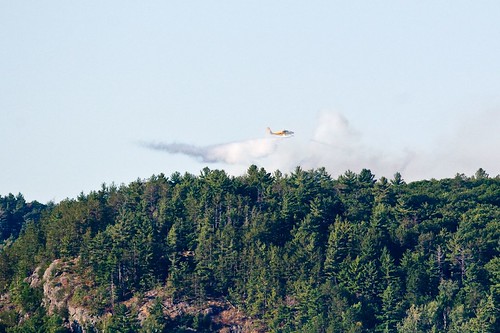
The call letters for the plane are C-COGA. It is a twin otter owned by the Ministry of Natural Resources.
Wednesday, July 18, 2007
Where Have All the Boomers Gone?
 Yesterday, I took a walk at noon hour to stretch my legs and buy some lunch at a nearby sandwich shop. It was a nice, sunny July day and I walked out of the office, down a fairly busy city street, into Liberty Village (an area of condos and shops) and into Select Sandwiches. During my walk, I saw lots of people going about their daily business. There were cab drivers, people riding bikes, pedestrians, shoppers and panhandlers. Maybe I'm a little slow on the uptake, but, for the first time I was struck by the thought that everyone in sight was younger than me! Much younger.
I was fascinated. I kept looking around for some grey hair in the crowd - maybe a business guy out for a stroll like me or a senior citizen driving by in his Buick, but to no avail. I remained the oldest guy in the neighbourhood. A 56 year-old codger surrounded by babies.
Where have all the baby boomers gone? At one point, we dominated everything. You couldn't move without bumping into a boomer. But almost overnight we seem to have melted into the woodwork, leaving the world to a bunch of kids. Not that there's anything wrong with that, but it all seemed to happen so suddenly. It's going to take a little getting used to, like having your first grandchild or realizing that all the women in the bar are staring through you like you don't exist any more.
Maybe that's it. Perhaps we're just invisible and I was surrounded by boomers on my walk, but just couldn't see them. Or maybe there's a hang-out that I don't know about where all the boomers go on their lunch hour, a place where they play psychedelic music and we all wear bell-bottoms and give each other the peace sign.
I wish it were true. Looking around my office from my sixth floor perch, I see a sea of shining, young faces. There are a handful of boomers still hanging on to our jobs, trying to keep up with the pace of change in this crazy world. The rest are retiring early, unable to keep up or tiring of the daily grind. Soon, we'll be hanging out in shopping malls with our running shoes on, doing laps on shiny linoleum before the shops open. We'll be having coffee and talking about our investments and the benefits of income funds versus annuities.
And so the world turns...
PS: the lovely young lady in the picture at the top of this post is Maggie, a friend of my grandson The picture is called Maggie and the Fan.
Monday, July 16, 2007
My Art Show
Sometimes fortune smiles at you and good things happen. Over the week-end, an art show opened up in the village of Blue Mountain (near Collingwood) featuring local artists and I'm one of 'em!
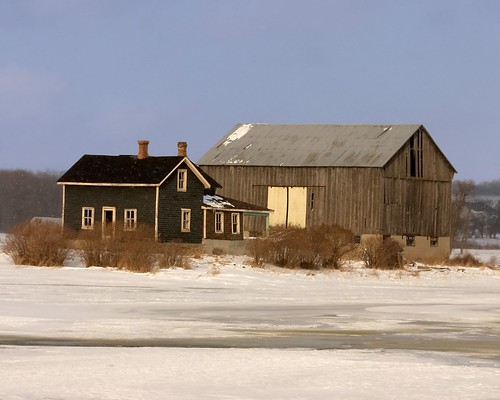
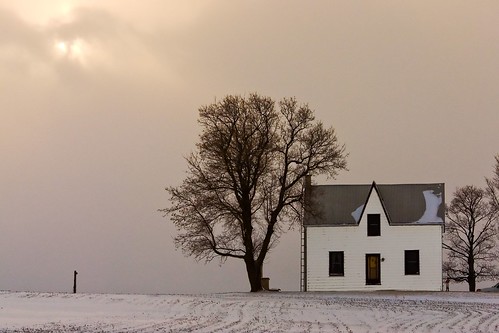
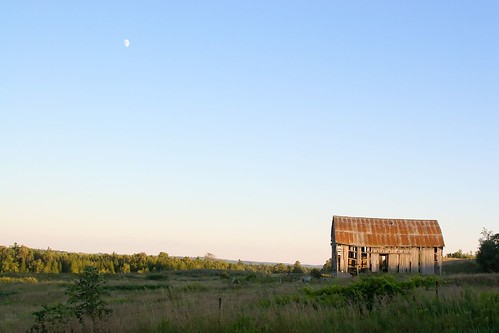
Each artist gets to hang their art in a window in the village. My window had six images, each 16x24. The images are from my "The Road North" series that looks at things that you might see out your car window on the way to the cottage or the ski hill. There are three winter landscapes and three summer landscapes.
Here are photos of the exhibit:


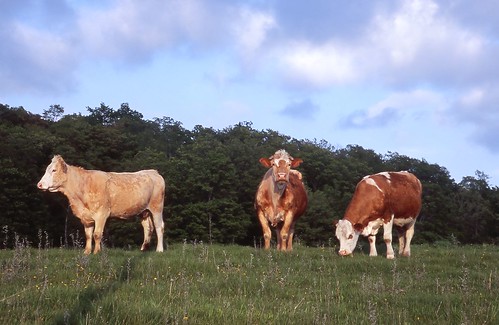
And, here are the photos in the exhibit. There are three winter scenes (Tractor Show June 3rd, the green house and the white house) and three summer scenes (Phonehenge, Lunar Gravity and See No Evil, Hear No Evil, Speak No Evil):


Each artist gets to hang their art in a window in the village. My window had six images, each 16x24. The images are from my "The Road North" series that looks at things that you might see out your car window on the way to the cottage or the ski hill. There are three winter landscapes and three summer landscapes.
Here are photos of the exhibit:


And, here are the photos in the exhibit. There are three winter scenes (Tractor Show June 3rd, the green house and the white house) and three summer scenes (Phonehenge, Lunar Gravity and See No Evil, Hear No Evil, Speak No Evil):

Thursday, June 21, 2007
Phonehenge
Interesting photos often come out of nowhere. I've been working on a series of images called "The Road North". My main interest is to photograph the ebb and flow of life - capturing the wave-like nature of our existence. In Canada, we have this strange habit of disappearing into the country to the north of us each and every week-end to ski, camp, canoe or cottage (yes, in Canada, to cottage is a verb). Motorists jam the highway on Friday night and Sunday night, up and down the road in a weekly migration. They are intent on their destination and often don't notice the odd things by the side of the road. But, I do.
It might be a particularly funky barn tumbling down despite the efforts of the farmer. Or, perhaps a white house on white snow. Or, a sloping barn roof pointing at the moon. Or, an old tour boat sitting on someone's lawn. Each of these images tells a story that begs to be captured.
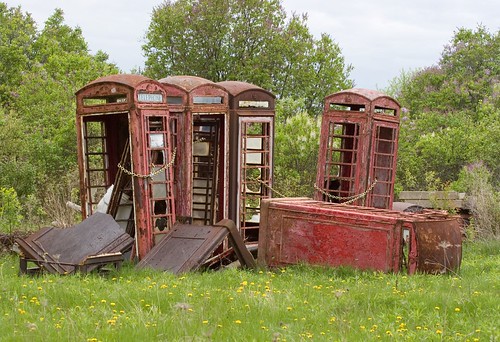
One day, I was driving along a country road on my way home from the cottage and I happened to spot something very odd out of the corner of my eye. I parked the car and walked into a farmer's field and found this image:

It looked like someone had started to buy up old Brit phone booths (now a protected species in the UK) with a view to fixing them up and selling them as decorations. A neighour in our area has one half way down his driveway. For some reason, the project looks to have been abandoned.
I was struck by the beauty of the rusty phone booths, the mystery of their presence in a farmer's field in Canada and their resemblence to Stonehenge. Who knows, an archeologist might stumble on these in the future and speculate that they were arranged in a circle for religious reasons.
Hence the title of the work: Phonehenge.
It might be a particularly funky barn tumbling down despite the efforts of the farmer. Or, perhaps a white house on white snow. Or, a sloping barn roof pointing at the moon. Or, an old tour boat sitting on someone's lawn. Each of these images tells a story that begs to be captured.
One day, I was driving along a country road on my way home from the cottage and I happened to spot something very odd out of the corner of my eye. I parked the car and walked into a farmer's field and found this image:
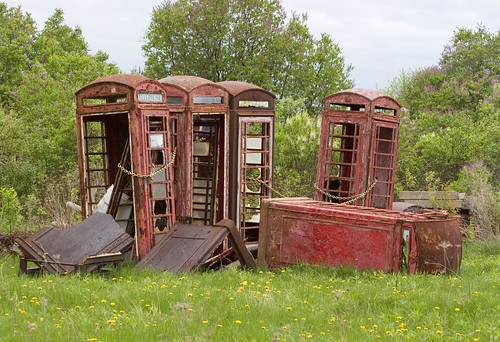
It looked like someone had started to buy up old Brit phone booths (now a protected species in the UK) with a view to fixing them up and selling them as decorations. A neighour in our area has one half way down his driveway. For some reason, the project looks to have been abandoned.
I was struck by the beauty of the rusty phone booths, the mystery of their presence in a farmer's field in Canada and their resemblence to Stonehenge. Who knows, an archeologist might stumble on these in the future and speculate that they were arranged in a circle for religious reasons.
Hence the title of the work: Phonehenge.
Subscribe to:
Posts (Atom)