Photography and Art

Wednesday, September 5, 2007

Serendipity


I'm always amazed when I look at a photograph and find something unexpected that takes the shot from one level to the other. I guess I don't look at the world with enough focus to actually see these things ahead of time. Like Mr Magoo, the old cartoon character, I seem to stumble on them. The law of averages dictate that the more photos you take, the better the chances of finding something interesting and serendipitous. Here's what I mean.

I was taking photos of Edmonton, a very interesting city that goes from low-rise prairie town to high-rise city in a matter of one city block. I saw a woman exit my hotel and light up a cigarette. Terrific, I thought, here's an opportunity to add to my smoker project. I like taking pictures of people smoking outside buildings -- they have an lovely contemplative aura to them. It was a nice picture of a woman smoking, leaning up against the wall. When I developed the photo, I was surprised to see a passing bus in the frame that had a fragment of the words "peace of mind" in it. What a lucky piece of luck!
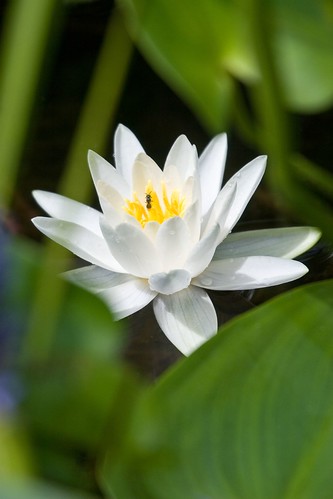

In a similar vein, I was bobbing around in a kayak on Sunny Lake in northern Ontario taking pictures of flowers in a small wetland adjacent to the lake. Later at home, I was developing the photos when I happened on a photo of a water flower that looked quite nice. The composition was fine and the flower was nicely in focus. When I looked more closely, I found an ant on the flower - posed like Yurtle the Turtle at the top of the plant, king of everything it surveyed. The photo transcended the original "post card" look and became a jumping off point for the viewer to create a story around the ant.

It just goes to show that there are terrific moments in time to be captured, when circumstances create a juxtaposition of elements that suggest a story or a mood. To capture these moments, you either have to be very good (think Henri Cartier-Bresson) or take a lot of pictures and be lucky!

Saturday, August 25, 2007

Forest Fire!

We just got back from a wonderful couple of weeks at our cottage in Haliburton, Ontario. Early one evening, Trish and I decided to take our kayaks out and paddle to the end of the lake. We came out of our bay and turned to the south, spending a lovely hour splashing along, paddling into the wind. As we made our way down the lake, pushing through the waves, we were vaguely aware of a float plane doing circuits behind us.

Float planes are a common occurence on our lake. In fact, the family who used to own our cottage have a float plane and they moved across the lake to a deeper anchorage so we see their plane taking off and landing quite often. However, this plane was a fairly large, bright yellow twin otter and it kept on taking off and landing.

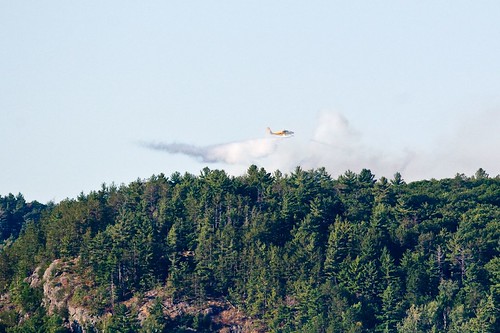
When we turned around to paddle back home, we noticed that the twin otter was actually dousing a small forest fire to the north east of our lake. It would swoop in from the east, taxi down the lake to take water into its pontoon tanks, take off and bank over the east shore of the lake and then do a run over the fire where it would empty its tanks over the fire. The plane kept this up seemingly for hours and, sure enough, by the next morning the fire was gone.

Here are pictures of the airplane taking on water, banking and then pouring water on the fire.


The call letters for the plane are C-COGA. It is a twin otter owned by the Ministry of Natural Resources.

Wednesday, July 18, 2007

Where Have All the Boomers Gone?

Yesterday, I took a walk at noon hour to stretch my legs and buy some lunch at a nearby sandwich shop. It was a nice, sunny July day and I walked out of the office, down a fairly busy city street, into Liberty Village (an area of condos and shops) and into Select Sandwiches. During my walk, I saw lots of people going about their daily business. There were cab drivers, people riding bikes, pedestrians, shoppers and panhandlers. Maybe I'm a little slow on the uptake, but, for the first time I was struck by the thought that everyone in sight was younger than me! Much younger.

I was fascinated. I kept looking around for some grey hair in the crowd - maybe a business guy out for a stroll like me or a senior citizen driving by in his Buick, but to no avail. I remained the oldest guy in the neighbourhood. A 56 year-old codger surrounded by babies.

Where have all the baby boomers gone? At one point, we dominated everything. You couldn't move without bumping into a boomer. But almost overnight we seem to have melted into the woodwork, leaving the world to a bunch of kids. Not that there's anything wrong with that, but it all seemed to happen so suddenly. It's going to take a little getting used to, like having your first grandchild or realizing that all the women in the bar are staring through you like you don't exist any more.

Maybe that's it. Perhaps we're just invisible and I was surrounded by boomers on my walk, but just couldn't see them. Or maybe there's a hang-out that I don't know about where all the boomers go on their lunch hour, a place where they play psychedelic music and we all wear bell-bottoms and give each other the peace sign.

I wish it were true. Looking around my office from my sixth floor perch, I see a sea of shining, young faces. There are a handful of boomers still hanging on to our jobs, trying to keep up with the pace of change in this crazy world. The rest are retiring early, unable to keep up or tiring of the daily grind. Soon, we'll be hanging out in shopping malls with our running shoes on, doing laps on shiny linoleum before the shops open. We'll be having coffee and talking about our investments and the benefits of income funds versus annuities.

And so the world turns...

PS: the lovely young lady in the picture at the top of this post is Maggie, a friend of my grandson The picture is called Maggie and the Fan.

Monday, July 16, 2007

My Art Show

Sometimes fortune smiles at you and good things happen. Over the week-end, an art show opened up in the village of Blue Mountain (near Collingwood) featuring local artists and I'm one of 'em!

Each artist gets to hang their art in a window in the village. My window had six images, each 16x24. The images are from my "The Road North" series that looks at things that you might see out your car window on the way to the cottage or the ski hill. There are three winter landscapes and three summer landscapes.

Here are photos of the exhibit:


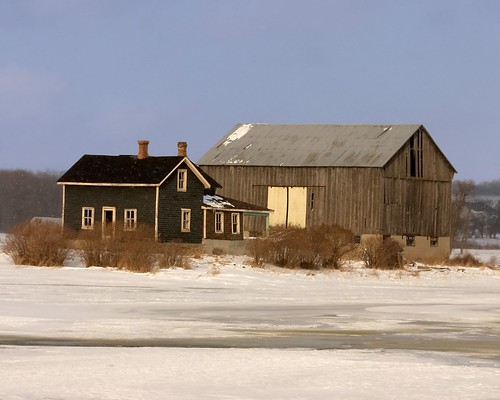
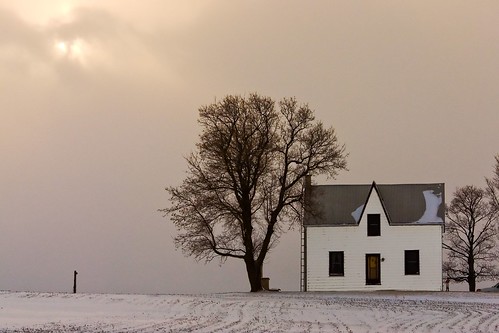
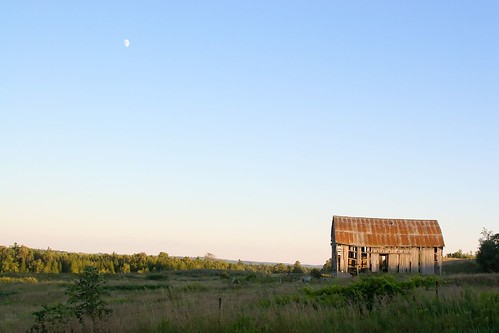
And, here are the photos in the exhibit. There are three winter scenes (Tractor Show June 3rd, the green house and the white house) and three summer scenes (Phonehenge, Lunar Gravity and See No Evil, Hear No Evil, Speak No Evil):


Thursday, June 21, 2007

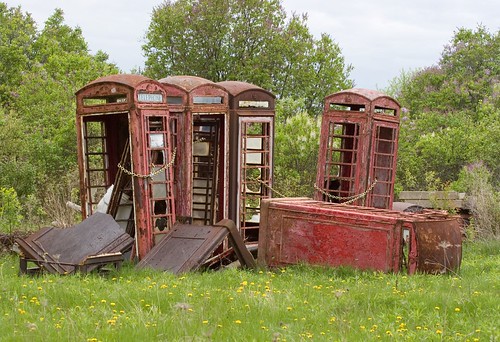
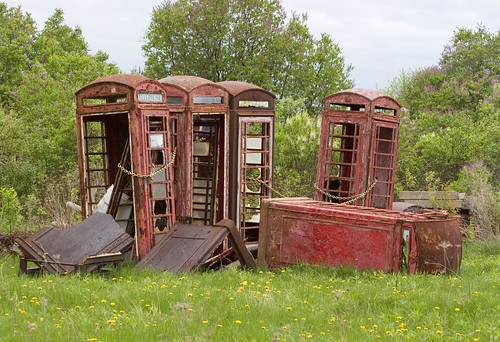
Phonehenge

Interesting photos often come out of nowhere. I've been working on a series of images called "The Road North". My main interest is to photograph the ebb and flow of life - capturing the wave-like nature of our existence. In Canada, we have this strange habit of disappearing into the country to the north of us each and every week-end to ski, camp, canoe or cottage (yes, in Canada, to cottage is a verb). Motorists jam the highway on Friday night and Sunday night, up and down the road in a weekly migration. They are intent on their destination and often don't notice the odd things by the side of the road. But, I do.

It might be a particularly funky barn tumbling down despite the efforts of the farmer. Or, perhaps a white house on white snow. Or, a sloping barn roof pointing at the moon. Or, an old tour boat sitting on someone's lawn. Each of these images tells a story that begs to be captured.

One day, I was driving along a country road on my way home from the cottage and I happened to spot something very odd out of the corner of my eye. I parked the car and walked into a farmer's field and found this image:


It looked like someone had started to buy up old Brit phone booths (now a protected species in the UK) with a view to fixing them up and selling them as decorations. A neighour in our area has one half way down his driveway. For some reason, the project looks to have been abandoned.

I was struck by the beauty of the rusty phone booths, the mystery of their presence in a farmer's field in Canada and their resemblence to Stonehenge. Who knows, an archeologist might stumble on these in the future and speculate that they were arranged in a circle for religious reasons.

Hence the title of the work: Phonehenge.


Tuesday, May 8, 2007

Photos of Animals

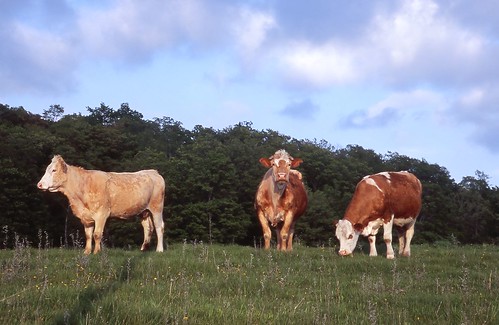
I enjoy photographing animals, mostly because I've been surrounded with pet dogs and cats since childhood and also because of the lure of capturing images of wild animals in their natural habitat. This must be a carry-over from my hunter ancestors because I really do enjoy stalking my prey and snapping photographs. I can bring home my "kill" on a compact flash card and display my trophies as photos, either on my wall or online.

My friend Mary Taylor recently returned from a holiday in Africa where she participated in a safari and captured some pretty nifty images. I'm jealous as hell. In comparison, I can only claim success in hunting down a mangy moose in Algonquin Park and a beaver swimming in his pond near my cottage. Somehow, that's just not the same as capturing a cheetah eating its kill.

I make do with visits to the zoo and nature preserves. The beauty of these environments is that you can get up close to the animals and, with a suitable lens (e.g. 70-300 mm on an APSC-sensor camera), you can get some good shots. You can also pick your weather and lighting conditions and go back several times to make sure you get the photos you want.

Mouflon - Toronto Zoo


In contrast, a trip to Africa typically lasts 2-3 weeks, the animals are free to come and go as they please and you just might not encounter good weather and lighting conditions at the time your "prey" decides to appear at the watering hole.

One of my favourite places to photograph animals is the Haliburton Wolf Reserve near Algonquin Park in Ontario, Canada. There is a typical wolf pack kept in a 75 acre reserve that is very close to their natural habitat. The wolves are fed by humans, but the feeding schedule is kept fairly erratic so that the pack is not allowed to lock into a schedule. When the pack is hungry, the wolves hang out near the food source, conveniently located next door to the viewing gallery. The gallery has thick glass that reflects the people in the gallery, presenting a challenge to the photographer.

Alpha Male watches from the woods


The best time to photograph wolves is in the wintertime where the trees are devoid of leaves, affording a good view of any shy wolves who stay back in the trees.

Strictly from an ecological point of view, zoos and reserves are probably a good thing. A trip to Africa carries a pretty hefty carbon consumption with it. Far better for the environment to bring the animals to the crowds instead of the crowds to the animals. Of course, there are many that argue that animals kept in artificial environments are disadvantaged somehow, but I'm not sure that the animals know or care whether they live in Africa or a suburb of Toronto.

Lion Couple Resting their Eyes


From a photographer's point of view, it is certainly more challenging and exciting to capture animals in their natural habitat. In the case of birds, it requires a great deal of patience and preparation or dumb luck. However, it is certainly possible to capture excellent images of animals in captivity that convey the essence of the beast. I don't think photographers should be ashamed of stalking animals in zoos or reserves and the popularity of the various zoo lover groups on flickr attest to the enjoyment that people get from this passtime. However, it just doesn't seem the same as chasing wild game in a land rover and shooting animals living life in the wild.


Tuesday, May 1, 2007

Industrial Landscapes

It has been awhile. I've been going through a stressful time of changing jobs (again) and haven't been in the mood to write.

Things are starting to resolve, so here goes a new post:

My daughter has a Scottish boyfriend, Ben, who works at Poscor, Canada's second largest re-cycling company. Ben is an avid amateur photographer, although he is a misguided individual who prefers Nikon to Canon. I guess he just likes soft lenses :-)

Ben was kind enough to invite me to tour the Poscor site. Re-cycling companies have been photographed by some famous photogs, including Edward Burtynsky. If you visit his site, navigate to the urban mines section of his works to see photographs of Poscor. In fact, the one entitled Densified Scrap Metal 3a is hanging on the wall of the Poscor office boardroom.

The day we visited was rather overcast, but it was bright enough to get some nice light on the subject without the harsh glare of direct sunlight. We did a tour of the Poscor yards in a pick-up truck, stopping every now and then to see the big machines at work processing scrap metal.

Poscor is a scrap re-cycling exchange. The company finds sellers of scrap (e.g. junkyards, auto plants) and buyers of scrap (e.g. steel companies). If possible, it merely gathers scrap from the source and re-distributes it to the buyer, collecting a fee in the process. Sometimes, the buyer requires that the scrap metal be processed, usually by chopping it into smaller chunks. This is done using several different techniques, ranging from sophisticated mechanised methods to manual brute force.

The most interesting machine on the lot is the shredder. This behemoth takes flattened car bodies as its raw material and uses a spinning rotor with huge hammers to pound the car bodies into shrapnel. The small pieces are then separated into steel and non-steel, with the steel being shipped to a local mill for re-cycling.

Great photographers don't work by taking a quick trip around the lot in a pick-up truck, getting out occasionally to snap off a few shots like I did. I'm told that Burtynsky spends a week or so in a location scouting out subject matter and shooting angles, then waits for the light to be perfect for realizing his vision.

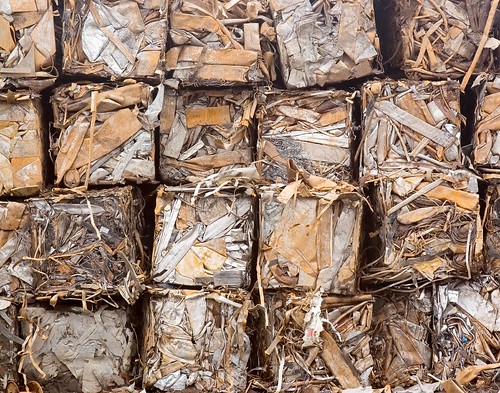
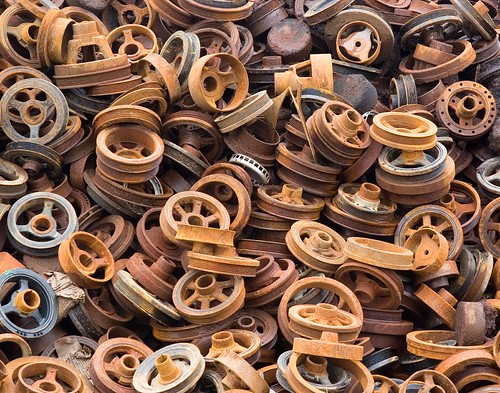
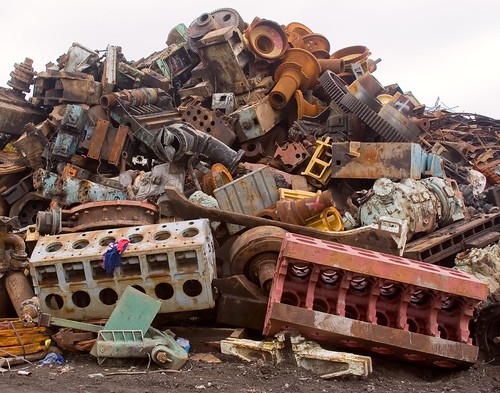
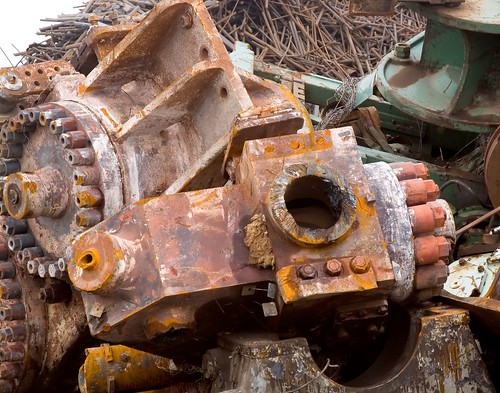
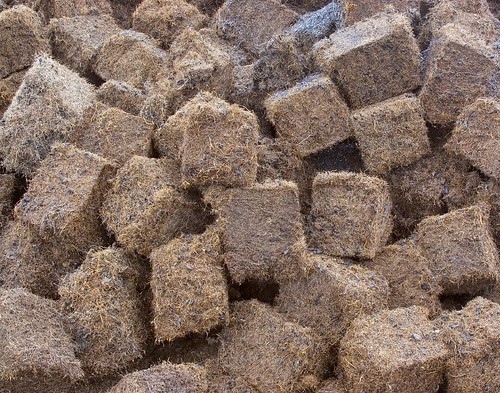
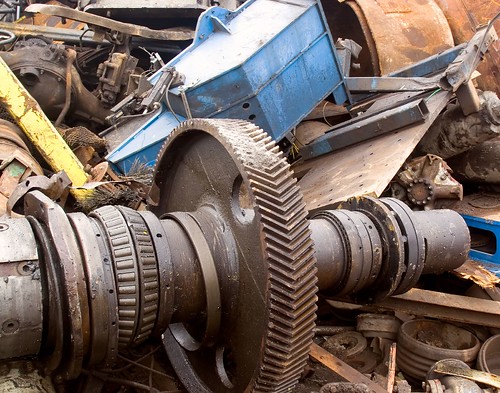
Nevertheless, I did get a half dozen shots that would pass for Burtynsky photos if you squinted from a distance and didn't look too carefully at the colour balance. Here is a selection:

Large Metal Bales


Assorted Sprockets


Mountain of Junk


Old Parts


Bales of Wire


The Gears